
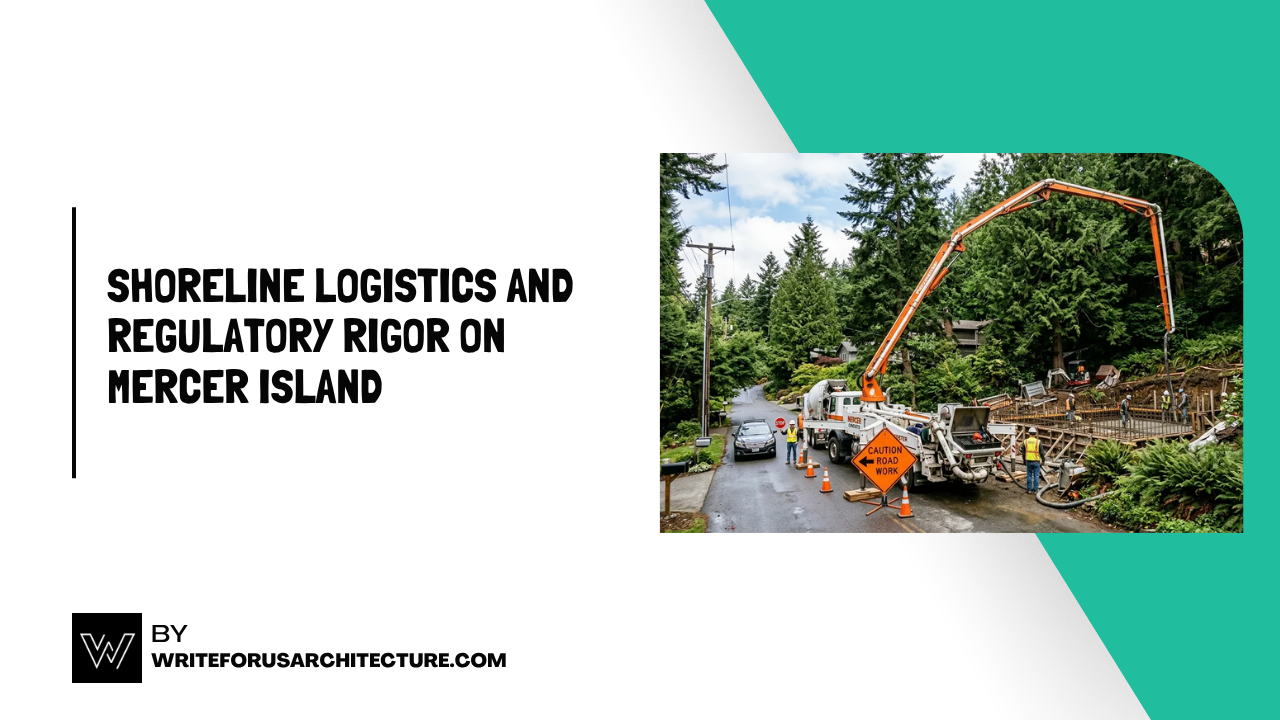
Mercer Island homeowners embarking on major residential projects face a uniquely demanding environment where Mercer Island home remodeling must balance luxury living with strict environmental protections and engineering realities. Surrounded by Lake Washington, the island’s shoreline properties, steep slopes, and sensitive ecosystems require meticulous structural engineering and logistical planning. Compliance with MICC 19.02 residential standards, the Shoreline Master Program (SMP), and critical areas regulations defines what is possible, often turning ambitious visions into carefully orchestrated, multi-year endeavors.
The island’s geography—elevated bluffs, narrow waterfront lots, mature vegetation, and proximity to water—creates both opportunity and constraint. Construction here demands more than standard building practices. It requires specialized knowledge of shoreline buffers, slope stabilization, permitting timelines, material delivery challenges, and seasonal work restrictions that protect the lake’s water quality and the island’s natural character.
Understanding Mercer Island’s Regulatory Framework
Mercer Island’s land use regulations emphasize environmental stewardship alongside residential development. Chapter 19.02 of the Mercer Island City Code (MICC) governs residential development standards, covering setbacks, height limits, lot coverage, and design criteria for single-family homes and associated structures. Projects must demonstrate consistency through detailed compliance matrices that address every applicable subsection.
For properties within shoreline jurisdiction—generally 200 feet from the ordinary high water mark of Lake Washington—the Shoreline Master Program (SMP) adds another rigorous layer. Adopted to comply with Washington’s Shoreline Management Act (RCW 90.58), the SMP prioritizes three core goals: encouraging water-dependent uses, protecting natural resources, and promoting reasonable public access where appropriate. Most development within the shoreline area requires either a Shoreline Substantial Development Permit or a Shoreline Exemption, with strict review of impacts on ecological functions.
Critical Areas regulations (Chapter 19.07 MICC) further overlay geologic hazard areas, including steep slopes, erosion zones, landslide risks, and seismic considerations. These rules ensure that new construction or substantial remodels do not exacerbate hazards or degrade sensitive habitats.
Steep Slope Stabilization: Engineering for Stability
Many Mercer Island homes sit on hillsides or bluffs with slopes exceeding 15-40% gradient, classifying them as steep slope hazard areas. Stabilization is not optional—it is foundational to project success and regulatory approval.
Geotechnical investigations by licensed engineers are mandatory for projects in or adjacent to these zones. Reports must evaluate soil composition, groundwater, slope stability factors of safety, and risks of erosion or sliding. Recommendations often include:
- Retaining Systems: Tiered concrete or modular block walls, soldier piles with lagging, or soil nail systems designed to handle lateral earth pressures while allowing natural drainage.
- Foundation Solutions: Deep pilings, mat foundations, or stepped footings that minimize soil disturbance and transfer loads to stable strata.
- Drainage Management: Extensive subsurface drainage systems, including French drains, interceptor trenches, and daylighting pipes to prevent hydrostatic buildup that could destabilize slopes.
- Erosion Control: Temporary and permanent measures such as silt fencing, hydroseeding, erosion control blankets, and bioengineering with native plants.
Construction on steep slopes faces seasonal limitations. Land clearing, grading, filling, and foundation work are generally prohibited between October 1 and April 1 on hazard lots to avoid wet-season failures. Waivers require compelling justification and additional geotechnical support demonstrating no increased risk.
These constraints influence project phasing. Excavation and stabilization often occur in the dry summer months, with careful sequencing to maintain slope integrity throughout the build.
Shoreline Master Program Constraints and Compliance
SMP rules significantly shape waterfront and near-shore projects. New shoreline stabilization (bulkheads, revetments) is heavily restricted and typically allowed only to protect existing primary structures where erosion threatens public safety or property. New development must be set back sufficiently to avoid future stabilization needs.
Key SMP considerations include:
- Buffers and Setbacks: Maintaining vegetated buffers to filter runoff, stabilize soils, and provide habitat. Reductions may be possible with mitigation but require detailed environmental assessments.
- Overwater Structures: Piers, docks, and boathouses face strict limits on size, materials, and impacts to navigation and aquatic life. Preferred alternatives emphasize minimal footprint and soft shoreline approaches.
- View and Access: Designs must respect neighboring views and incorporate public access elements where feasible.
- Cumulative Impacts: Review evaluates not just the individual project but broader effects on shoreline ecological functions.
Permitting integrates SMP review with building permits, often requiring coordination among architects, structural engineers, civil engineers, geotechnical consultants, and environmental specialists. Pre-application meetings with city staff help identify issues early.
Logistical Challenges of Island Construction
Beyond regulations, Mercer Island’s geography creates distinct logistical hurdles. Limited access points, bridge crossings (I-90), and narrow residential streets complicate material delivery and equipment mobilization. Large trucks or cranes may need special routing, timing, or temporary road improvements.
Construction staging is constrained on smaller lots. Contractors must develop detailed site utilization plans that minimize disruption to neighbors and protect existing trees and vegetation—another key city priority. Noise ordinances, dust control, and hours of operation add further discipline to daily operations.
Utility upgrades often accompany major projects. Older homes may require new service laterals for water, sewer, electrical, and stormwater, with added complexity near the shoreline due to protected infrastructure corridors and environmental sensitivities.
Waste management and material recycling are emphasized to reduce truck trips and environmental footprint. Innovative approaches—such as modular construction components or off-site prefabrication—can reduce on-site disruption and speed timelines.
Structural Engineering Excellence in a Sensitive Context
Successful projects integrate structural engineering with all other disciplines from the outset. Engineers design for:
- Seismic resilience (Mercer Island lies in a moderate seismic zone).
- Wind loads on exposed waterfront sites.
- Differential settlement on variable soils.
- Integration of green building features like rainwater harvesting or high-performance envelopes that also support regulatory incentives.
Advanced modeling tools, including finite element analysis for complex foundations and 3D BIM coordination, help optimize designs while ensuring constructability. Monitoring during construction—slope inclinometers, settlement markers, vibration sensors—provides real-time data to verify assumptions and protect adjacent properties.
For remodels of existing homes, engineers assess the capacity of the current foundation and framing. Selective reinforcement or full underpinning may be necessary when adding square footage, upper levels, or modern open layouts that alter load paths.
Integrated Project Delivery for Success
The most effective approach on Mercer Island is early, collaborative planning. Assembling a team experienced with local conditions—including land use attorneys, surveyors, and consultants familiar with city staff preferences—streamlines the path from concept to permit.
Feasibility studies incorporating zoning analysis, topographic surveys, geotechnical borings, and environmental assessments identify constraints and opportunities before significant design investment. This prevents redesign cycles that inflate costs and timelines.
Phased construction minimizes risk: stabilization and foundations first, followed by structural framing during optimal weather, then interior and site restoration. Thorough documentation and proactive communication with regulators and neighbors reduce objections and delays.
Long-Term Value and Stewardship
Projects executed with this level of rigor deliver homes that are not only beautiful and functional but also resilient, compliant, and appreciative of the island’s unique setting. They enhance property values while protecting the lake and community character that make Mercer Island desirable.
Homeowners benefit from lower long-term maintenance, energy efficiency, and peace of mind knowing their investment withstands the island’s environmental forces. Thoughtful integration of native landscaping, low-impact development, and habitat-friendly designs often exceeds minimum requirements and earns community goodwill.
Navigating Mercer Island’s shoreline logistics and regulatory rigor demands expertise, patience, and precision. For those ready to undertake significant residential work, partnering with a proven team ensures that challenges become opportunities for exceptional, enduring results.
Elite Remodeling Seattle brings specialized knowledge of these island-specific demands, delivering projects that respect Mercer Island’s strict standards while realizing homeowners’ visions for elevated lakeside living.